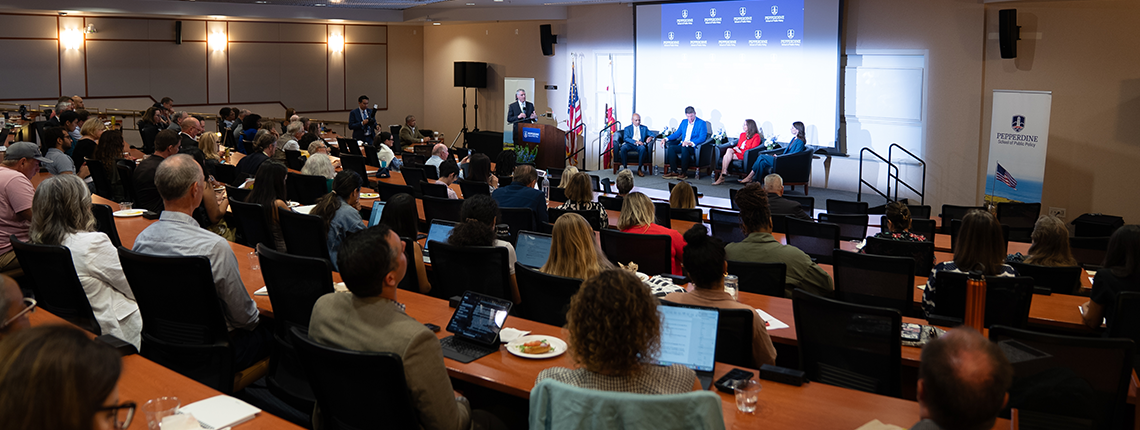
Viewpoint Diversity at Pepperdine's School of Public Policy
Where Intellectual Inquiry Can Thrive
At Pepperdine's School of Public Policy, viewpoint diversity is a foundational principle—inside and outside the classroom—and a necessity in higher education. We asked graduate policy students what viewpoint diversity means to them and how they experience it in the classroom.To say that academia is politically progressive is a generally accepted fact of American life. But for a graduate policy program tasked with preparing our next generation of public leaders, it is of primary importance that we practice viewpoint diversity both inside and outside the classroom. In today's polarized public square, leaders must know not only their own intellectual foundations, but also those with whom they disagree.
National surveys continue to show that today's undergraduates, particularly conservative students and students of faith, feel they must squelch their political opinions out of fear of retribution from fellow students, faculty, and administrators. A recent national survey by the Heterodox Academy found that more than half (58.8%) of college students were reluctant to discuss potentially controversial political or social issues on campus. The same survey revealed almost two-thirds of students believed their campus culture "prevents people from saying what they believe because others might find those views offensive."
Pepperdine as an "Edenic Campus" for Viewpoint Diversity
In his important ground-breaking book, coauthored with Joshua Dunn, Passing on the Right: Conservative Professors in the Progressive University, Jon Shields examines these issues through over 150 interviews with mostly conservative professors at universities around the country. He finds many professors who relish their uniqueness in the workplace, while others having to hide their political views . . . at least until they earn tenure.
Notable, is that the name of every interviewee, and their affiliated college or university is kept confidential. At the beginning of the book's fifth chapter, the authors describe how their research began with interviews of two SPP faculty: Robert Kaufman and the late Ted McAllister. Describing SPP as an "Edenic campus" for welcoming scholars and students with differing political viewpoints, Shields and Dunn remarked at the vastly different culture here in Malibu in comparison to other campuses they visted in the course of researching for the book.
From our founding back in 1997 with faculty like James Q. Wilson, Congressman Jack Kemp, Michael Novak, and Kevin Starr to today with full-time and visiting professors including Victor Davis Hanson, Karen House, Steven Hayward, and Kiron Skinner, it is fair to say our faculty are incredibly skilled in hosting tough classroom discussions on polarizing policy topics, even as they support students throughout their careers no matter what their political affiliation.
Why is it Important?
What you'll hear our students say—both conservative and liberal, faith-inspired or not—is that Pepperdine School of Public Policy provides a welcoming and challenging environment to everyone. From our Great Ideas: Ethics, Culture, Markets, Politics, and Technology coursework to invited speakers, our "City on a Hill" campus offers the unique opportunity to think critically about one's own perspective as well as others', producing leaders who are humble, collaborative and optimistic about the future.
Related Articles:
| Articles |
|---|
|
Thought Control And Cancel Culture Overtakes Colleges And Universities, Pete Peterson (MPP '07) |
|
Is the 'Eggshell Culture' on Campus Moving Into Our Public Square?, Pete Peterson (MPP '07) |
|
Why "Viewpoint Diversity" is so Important at SPP Blog, Pete Peterson (MPP '07) |