Public Leaders
with a "Moral Sense"

Initiatives
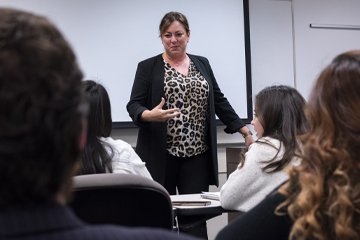
Education Policy & Impact
Preparing future and convening current leaders in education policy.
The "Education Policy and Impact" initiative based at the School of Public Policy is a multi-part initiative intended to both prepare policy leaders as it engages current policymakers in civil discussions about the future of America's education system. Launched in the fall of 2019, this program builds upon the existing work SPP has undertaken in coursework, research, and public events.

HSAC@SPP
Catalyzes and supports a multi-jurisdictional and comprehensive approach to preparedness, security, and resiliency in the Los Angeles region.
The Homeland Security Advisory Council at the School of Public Policy (HSAC@SPP) is an innovative academic enterprise focusing on disaster preparedness, crisis management, and resiliency through engaging the public, private, and civic sectors. HSAC@SPP is a robust cross-sector initiative, positioned to prepare the current and next generation of leaders by exploring a full range of cross-sector and information technology solutions to public policy challenges.
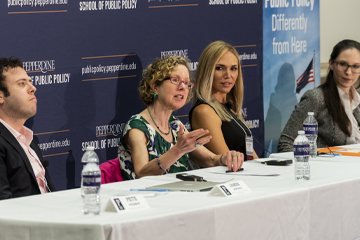
Viewpoint Diversity
Preparing public leaders to consider and understand a diverse range of ideological perspectives.
To say that academia is politically progressive is a generally accepted fact of American life. But for a graduate policy program tasked with preparing our next generation of public leaders, it is of primary importance that we practice viewpoint diversity both inside and outside the classroom. In today's polarized public square, leaders must know not only their own intellectual foundations, but also those with whom they disagree.

Academic Research
Shaping public policy conversations through authorship and initiatives.
The Pepperdine School of Public Policy is committed to constructing a vibrant community of academic and scholarly excellence in which faculty and students study, investigate, learn, and flourish together. Through research conducted by the Davenport Institute for Public Engagement and Civic Leadership, leading-edge faculty research, and annual policy research seminars, you will have limitless opportunities to become involved with scholars who conduct dynamic and internationally-recognized policy research.
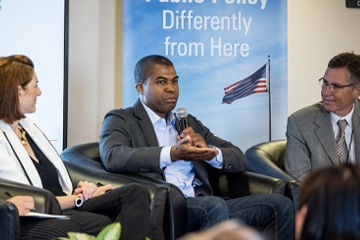
Cross-Sector Leadership
Supporting creative public problem-solving across government, business, and nonprofit sectors.
In their important book on public leadership, The Solution Revolution, government consultants Bill Eggers and Paul MacMillan note that America is undergoing a tectonic change in how it responds to public policy challenges—"a shift from a government-dominated model to one in which government is just one player among many." Into this new dynamic Eggers and MacMillan add, "social impact becomes a form of currency with real value to millions—from foundations to governments to venture philanthropists to individual citizens."
Wavemaker Testimonials

Very few schools in the public policy arena really give you both sides of the equation, and I thought that was a really good asset as I was going to seek a career in public service."
Director Office of Emergency Management
County of Los Angeles Chief Executive Office
Events
detecting…
n/a
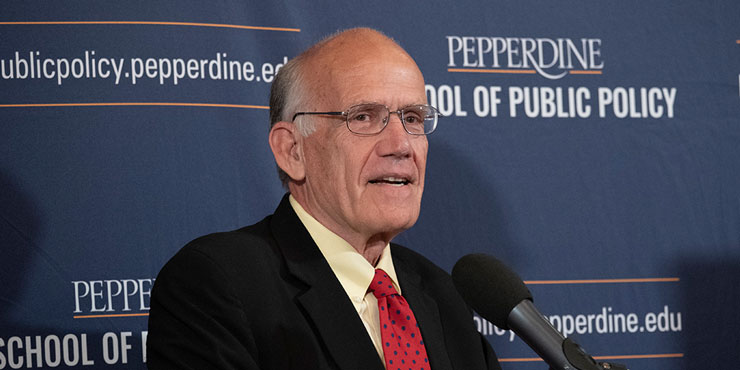
Victor Davis Hanson, the Martin and Illie Anderson Senior Fellow at the Hoover Institution and former William E. Simon Distinguished Visiting Professor at the Pepperdine School of Public Policy, will return to Pepperdine in fall 2023 to serve as the inaugural Terry Giles and Kalli O'Malley Distinguished Visiting Professor at the School of Public Policy.
Newsroom